I joined a guided wild herb tour led by a certified herbal educator in a nearby village. The tour took place at the abandoned site of a former German Army ammunition production facility and depot from the Second World War, known as MUNA Hohenbrunn (MUNA stands for the German word Munitionsanstalt). I was eager to take some nice macro photos of the wild herbs and test out my new budget macro photography technique which I learned from a YouTube Video by Christina from Photosprouts.
The sprawling grounds of the former MUNA, once a secret and heavily guarded ammunition depot, now offer a unique habitat for numerous plant species. Since the area was little used for decades and was largely left to its own, a remarkable diversity of plant life has been preserved here. At MUNA, we discover unique wild herbs that fascinate us because of their rarity and properties.
Prepare Your Gear: 7 Essentials and selecting the Right Lens
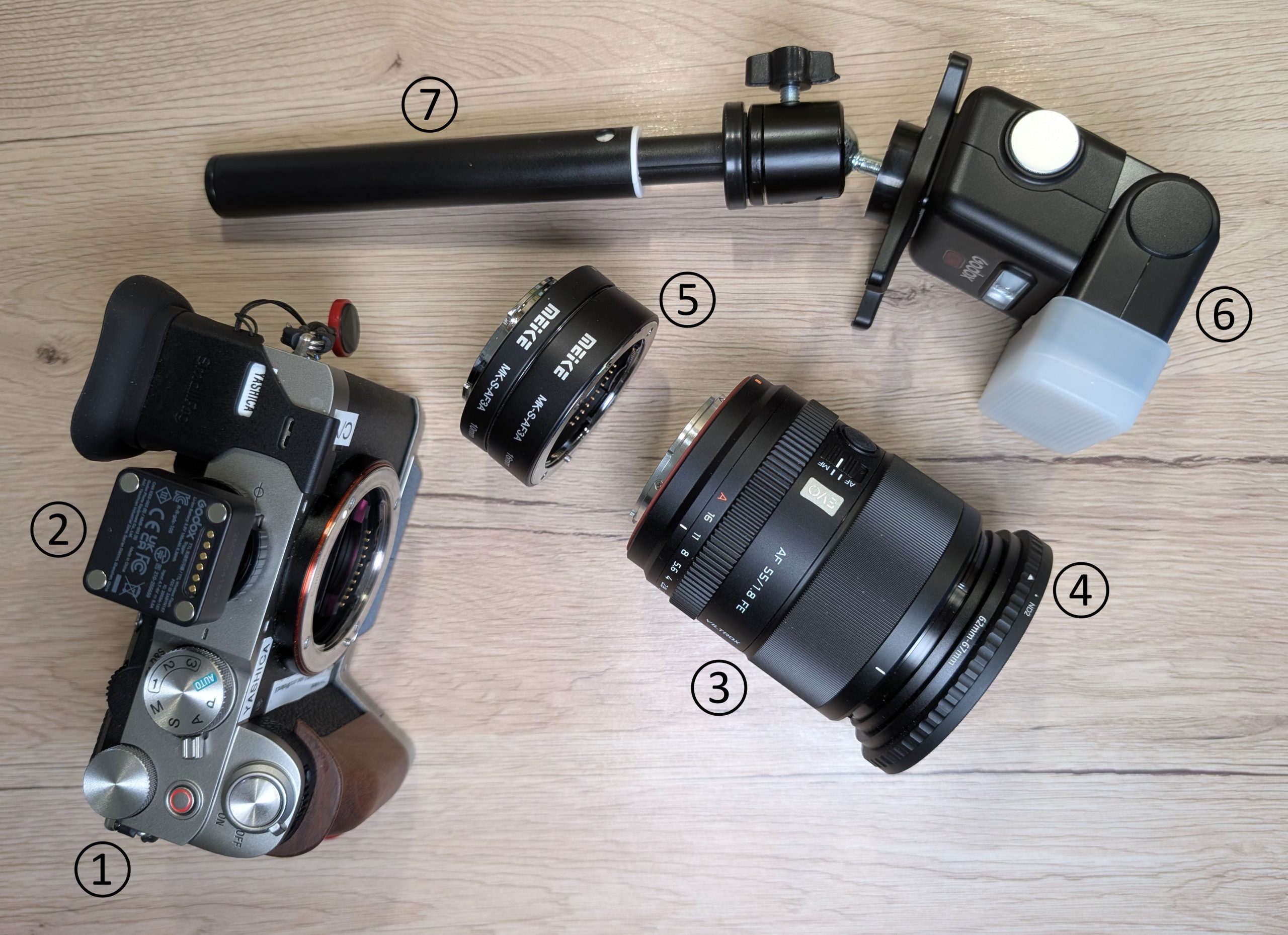
Before the guided tour, I did the following homework: I tested all my better lenses using extension tubes to see which one provided the best magnification, as close to a macro factor of 1:1 as possible.
In my case, the relatively new Viltrox 55mm f/1.8 APO (apochromatic) lens with the extension tubes suprisingly turned out to provide the best macro factor of my better lenses. I did’t expect this, as the minimum focus distance of this lens without xtension tubes is a high 43 cm.
To test out the macro factor of the Viltrox 55mm f1.8 APO (apochromatic) lens with the Meike extension tubes, I did photograph a old folding ruler from as close as possible while still delivering a sharp image from left to right.
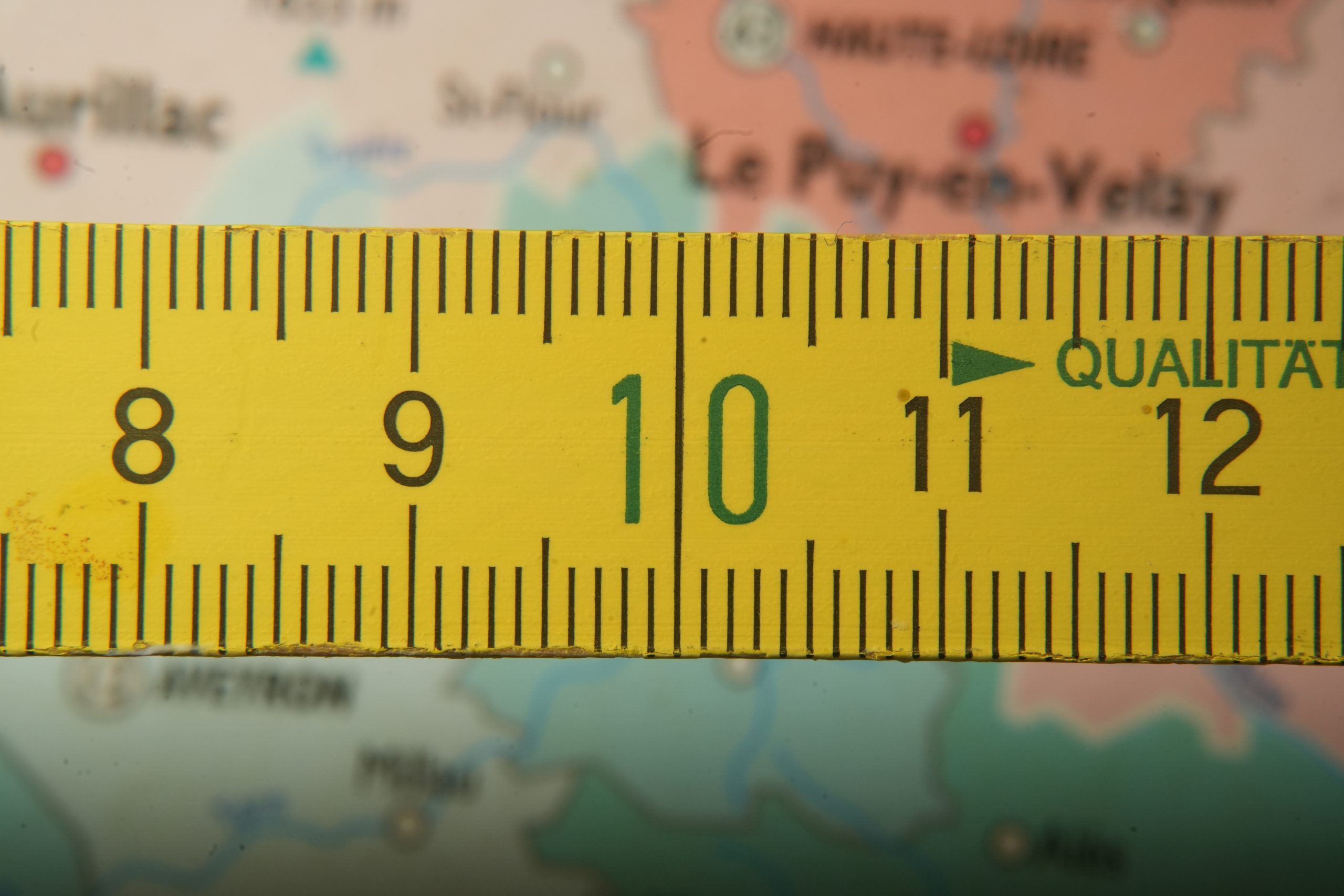
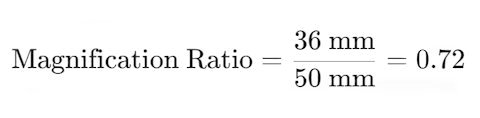
To calculate the magnification ratio (macro factor) of your setup, we simply compare the actual width of the photographed object with the width of your camera sensor that it is projected onto. My Sony a7Cii camera features a full-frame sensor with a width of 36 mm.
The formula is:
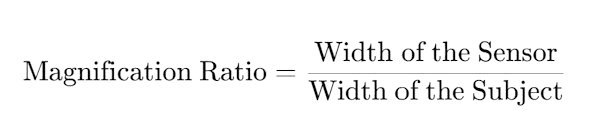
Plugging in my values:
Macro Factor of my lens and extension tube setup
My setup utilizing the Viltrox 55mm f/1.8 APO (apochromatic) and the Meike extension tubes achieves a magnification ratio of 1:1.39 (or rounded to 0.72:1). Lets say, my setup has a macro factor of approx. 1:1.4
What does this mean in practice? A “true macro” standard is considered to be 1:1 (where a 36 mm long object fills the full-format sensor exactly). With your extension tube setup, I am incredibly close to that benchmark. An object is projected onto my sensor at roughly 72% of its real-world size. For the vast majority of wild herbs and details at the MUNA site, this magnification ratio is more than enough to capture fine wild herb structures with razor-sharp detail.
With a macro factor of 1:1.4, the Viltrox 55mm f/1.8 APO (apochromatic) lens provides a surprisingly comfortable approx. 7 cm distance from the object, making it easy to position the IT32 off-camera flash to shape the light from the side.
Here are my shooting method steps which I followed to shoot the wild herbs
- Things to take with you in your camera bag: A mirrorless camera; extension tubes; a variable ND filter with a range of approx. ND2 to ND32; a small off-camera wireless flash and trigger; and a short holding stick with a 1/4″ screw to which the flash magnetic holding shoe is mounted.
- Place both extension tubes between the camera and the lens.
- Set your camera to manual mode and minimum sync speed. I try to avoid high-speed sync (HSS) whenever possible for a stronger flash power. For my Sony α7cii, this is a shutter speed of 1/160 s.
- Set the lens aperture to a higher value like f/11 to achieve a deeper area of sharp focus.
- Set your ISO and variable ND filter to adjust your manual settings for a dark ambient light photo without flash. Set a dark background while still making the objects in the background a little bit visible.
- Take some test photos to check your manual camera settings for the ambient light.
- Focus manually on the wild herb using focus peaking, then start flashing from the left or right side onto the herb with the wireless flash, initially set to manual 1/64 power. Take some test photos while adjusting the manual flash power setting until the herb is illuminated correctly.
- Take photos of all your wild herbs. I did not need to adjust my manual camera or flash settings while photographing all herbs.
Why is this macro technique on a budget?
You probably don’t need to buy an expensive macro lens because you can often use the lenses you already own with inexpensive extension tubes (I got my extension tubes for approx. EUR 30). In addition: Using an approx. EUR 100 off-camera wireless flash allows you to create your “perfect” lighting of the macro object in focus.
Macro photos of the wild herbs at the Second World War lost place of MUNA Hohenbrunn
When you click on an image in the galleries, following buttons will allow you to select some features. Use Original-size to watch the photo in full resolution:
Slideshow | Fullscreen | Image-Info | Original-size
I am quite satisfied with the macro photos. Using the Viltrox APO (apochromatic) lens with full optical correction was probably a good decision. It was also very helpful that I didn’t need to get too close to the herbs.
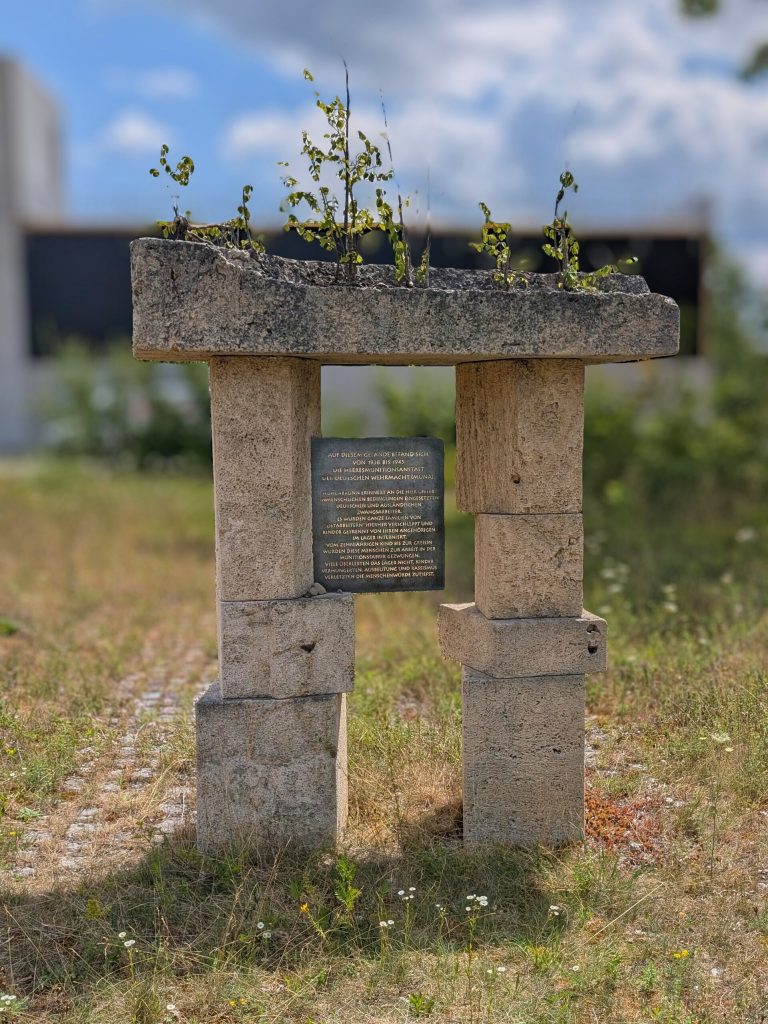
This is the tragic history of the MUNA Hohenbrunn munitions production and storage facility during the Nazi regime
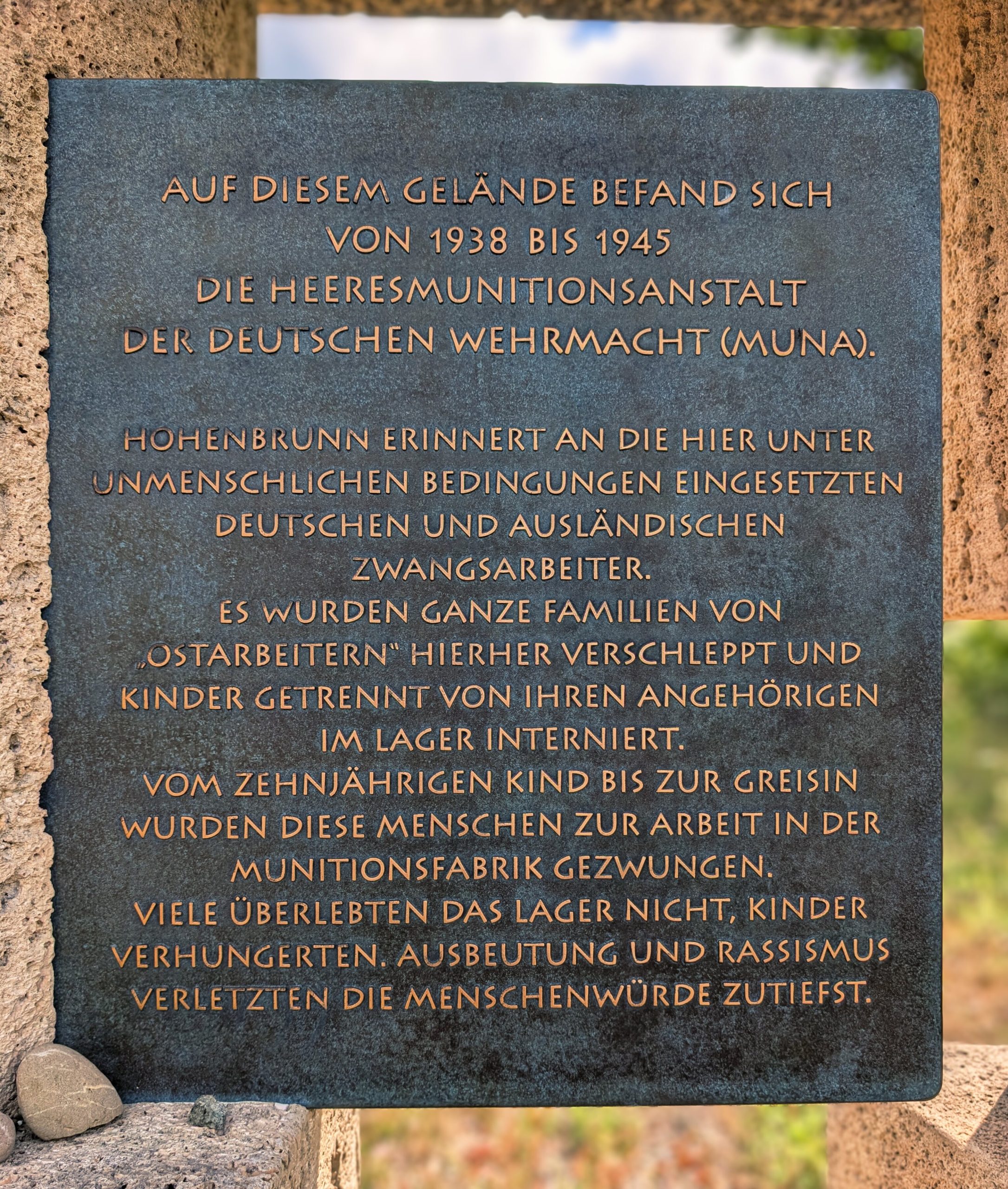
FROM 1938 TO 1945, THE ARMY AMMUNITION PLANT OF THE GERMAN WEHRMACHT (MUNA) WAS LOCATED ON THESE GROUNDS.
HOHENBRUNN REMEMBERS THE GERMAN AND FOREIGN FORCED LABORERS DEPLOYED HERE UNDER INHUMAN CONDITIONS.
ENTIRE FAMILIES OF “OST-ARBEITER” (EASTERN WORKERS) WERE DEPORTED HERE, AND CHILDREN WERE INTERNED IN THE CAMP SEPARATED FROM THEIR RELATIVES.
FROM TEN-YEAR-OLD CHILDREN TO ELDERLY WOMEN, THESE PEOPLE WERE FORCED TO WORK IN THE AMMUNITION FACTORY.
MANY DID NOT SURVIVE THE CAMP; CHILDREN STARVED TO DEATH. EXPLOITATION AND RACISM PROFOUNDLY VIOLATED HUMAN DIGNITY.
Source: Inscription on the MUNA (Munitionsanstalt) memorial
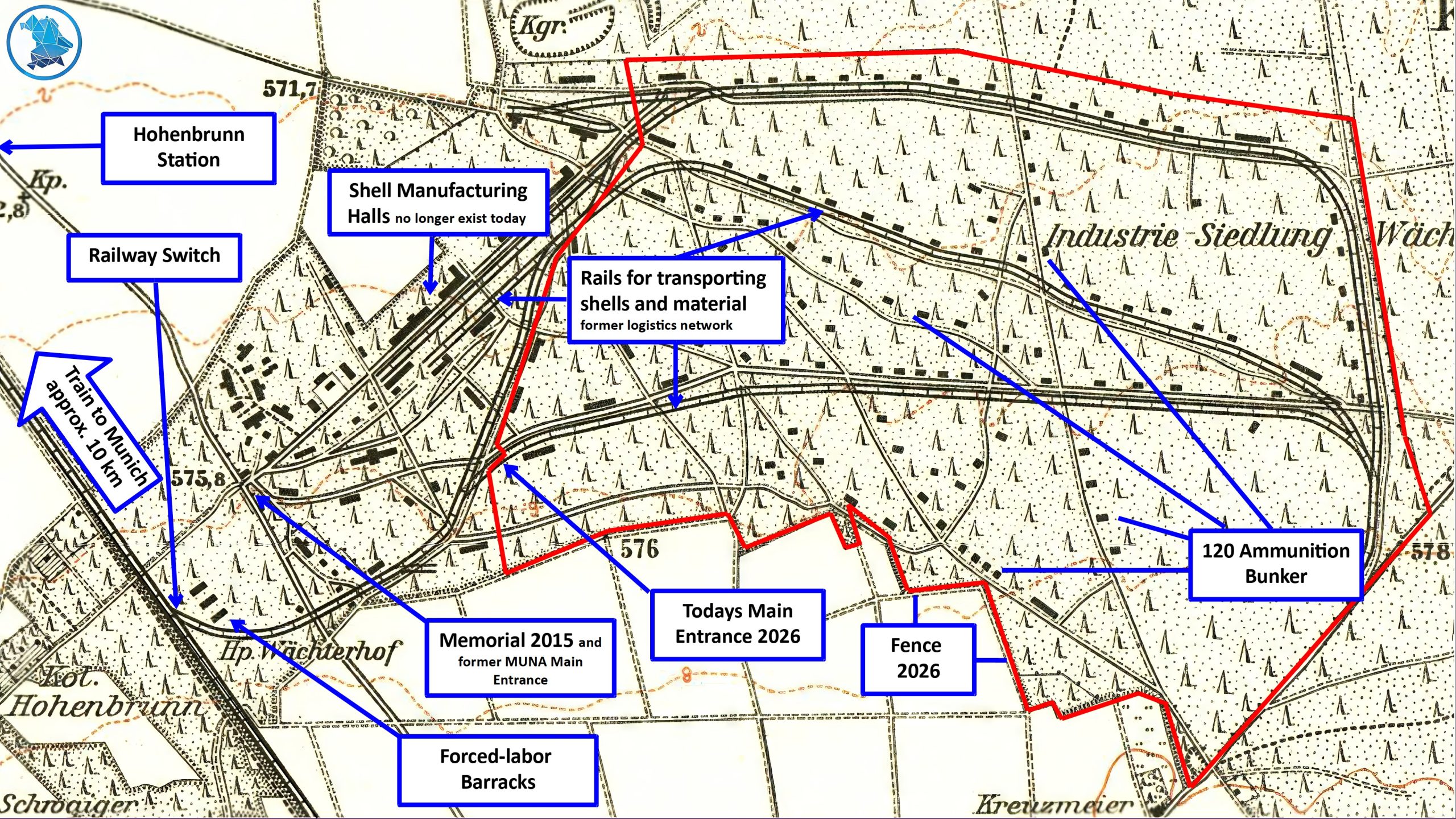
Deep in the German woods approx. 10 km southeast of Munich, Germany, lies an abandoned Second World War ammunition depot and production site, known historically as a MUNA (Munitionsanstalt). This specific site holds a dark history, having relied heavily on more than 750 forced labors from Ukraine, Russia, Poland, France, Italy and other occupied countries, to produce ammunition. Source: Hohenbrunn im Nationalsozialismus: Die Ortsgeschichte von 1933 bis 1945 by Annemone Christians and Florian Wimmer.
When you click on an image in the galleries, following buttons will allow you to select some features. Use Original-size to watch the photo in full resolution:
Slideshow | Fullscreen | Image-Info | Original-size
During Second World War, the Hohenbrunn MUNA forced hundreds of laborers to work simultaneously under brutal conditions. Today, the fates of around 750 of these individuals can be verified by name through records in the Arolsen Archives.
In 2011, the skeletal remains of 21 children (aged approximately 6–10) were identified after bones were found by kids at a gravel deposit near the former MUNA Hohenbrunn. Historical investigations and forensic examinations concluded that the children were Ukrainian or Russian and belonged to families of forced laborers who had been brought to work at the Wehrmacht munitions plant. Historians had long suspected the existence of a grave associated with the camp, although the exact circumstances of the children’s deaths remain unclear.
Source: Münchner Merkur, Grusel-Fund: Kinder-Knochen in Kiesgrube entdeckt 30.09.2011
The location of the MUNA Hohenbrunn forced-worker graveyard (confirmed to exist and called Russenfriedhof in official local documents in 1946, to be found in the Arolsen Archives) remains unknown to the public.
“Macro Photo Technique on a Budget” by Christina from Photosprouts in San Francisco, California
Thank you to Christina for sharing her budget macro photography technique using a small wireless flash and extension tubes!
Google Maps location of the MUNA memorial
Google Maps location of the MUNA Hohenbrunn memorial: https://maps.app.goo.gl
Don’t hesitate to leave a comment below
Your comments are highly valued. Please note that comments undergo manual verification to prevent spam, which may cause a delay in their appearance.