
January 2026 updates of this article: Adding a Meshtastic vs. MeshCore comparison table; comparing the reachability of Meshtastic & MeshCore Organizations; adding information about MQTT support and several details.
Here are some things to know about both projects
Both Meshtastic and MeshCore are designed for the same basic purpose: enabling decentralised, off-grid communication via low-power LoRa radio. They allow text messages and GPS data to be sent over long distances without the need for cellular networks, Wi-Fi or an internet connection.
Meshtastic and the relatively new project MeshCore are two separate, different software projects that are not compatible with each other. However, both use inexpensive LoRa hardware.
The Origins of Meshtastic
The initial concept for Meshtastic, created by Kevin Hester (USA), appeared on GitHub in 2019. The project was founded to enable off-grid, long-range, low-power communication using LoRa radios. The project gained traction in early 2020 through public firmware releases and community adoption, particularly via the Meshtastic Forums and GitHub.
The project grew rapidly 2021 onwards with many contributors, new hardware integrations (like T-Beam, T-Echo, and RAK devices), and wide adoption for emergency communication, hiking, and disaster resilience.
In 2022, the project saw major firmware developments, including improved mesh routing, security enhancements like encryption, and extended capabilities such as MQTT integration for bridging the mesh with external systems. Version 2.0, with better routing algorithms, was also released around this time.
From 2023 to 2025, Meshtastic has continued to evolve as a community-maintained, open-source ecosystem with growing global participation.
The Origins of MeshCore
MeshCore appears to have been launched in early 2025 by Scott Powell (Australia). Scott created an informative MeshCore year 2025 review blogpost at Ripple Radios. A MeshCore core team was established at an early stage in 2025. Andy Kirby (UK): early tester, MeshCore YouTube content creator, community engagement, and maintenance of the MeshCore website. Rastislav Vysoky (Slovakia): author of the first web client, the MeshCore map, and the web flasher; he also handled the majority of technical support. Liam Cottle (New Zealand): developed an improved web client and then rapidly delivered a native mobile client.
The goal from the outset was to provide a lightweight, multi-hop LoRa-based mesh communication system independent of the internet or cellular infrastructure, suggesting a fresh code-base rather than a direct fork of something else.
Meshtastic vs. MeshCore Comparison Table
| Category | Meshtastic | MeshCore |
|---|---|---|
| Purpose & Design Philosophy | Ad‑hoc, dynamic LoRa mesh for easy off‑grid communication and simple messaging. | Structured, scalable LoRa mesh with configurable multi‑hop routing and distinct roles for repeaters and clients. |
| Routing Method | Managed flooding: every node rebroadcasts messages until max hops. | Configurable multi‑hop routing: dedicated repeaters route more efficiently, learn paths and reduce flooding. |
| Hop Count / Reach | Typically up to 7 hops. | Supports up to 64 hops, more reliable and longer range networking. |
| Network Traffic & Efficiency | Higher traffic due to flooding (less efficient with many nodes). | Lower traffic; routing reduces unnecessary rebroadcasting and congestion. |
| Device Roles | Switchable roles: CLIENT, CLIENT_MUTE, ROUTER, ROUTER_LATE, TRACKER, SENSOR, among others. | Distinct firmware roles: Companion (user device), Repeater (infrastructure), Room Server. |
| Encryption & Security | AES‑256 shared key; optional end‑to‑end encryption. | Stronger options: AES‑256‑GCM or ChaCha20‑Poly1305 with identity attestation. |
| Message Delivery | No built‑in delivery confirmation; relies on flooding. | Confirms delivery/failure; more reliable routing. |
| Telemetry & Sensor Data | Built‑in GPS and telemetry; broad sensor support. | Limited telemetry by default; focus on messaging efficiency. |
| Community & Ecosystem | Larger, long‑established community with many integrations. | Smaller, newer community focused on structured deployments. |
| Ease of Use / Deployment | Easy setup; no to minimal pre‑planning required. | Requires planning and some configuration (epsecially for repeaters). |
| Use Case Focus | Best for spontaneous, dynamic off‑grid communication (hikes, events, outdoor). | Best for planned, larger networks with infrastructure (community networks, IoT, smart farming). |
| MQTT | Integrated MQTT module for easy information exchange with other systems like Home Automation OS. | MQTT is not integrated, a separate gateway must be set up. |
| License | All parts are open source under GPL license, new code based on existing open source code has to stay open source. | The core is open source under an MIT license. Some apps and parts are proprietary, and new code could switch from open source to proprietary due to “commercial capture.” |
Your Use Case is missing?
Meshtastic and MeshCore are continuously evolving projects, with new use cases emerging all the time. Please feel free to contribute to this article by leaving a comment below. Alternatively, you can email to mesh@swiss-1.ch.
1. Potential use cases in which Meshtatic appears to be the more technically suitable option
Meshtastic is currently the better-known and more widely used project, building a ‘flooding mesh’ network. This means that every device on the network acts as both a client and a repeater by default. When you send a message, every node that receives it forwards it until it reaches its destination or the maximum number of ‘hops’ is reached. It appears to perform stateless message passing.
Motto: ‘Keep it simple, transparent and useful for people, especially in ad-hoc situations.’

Outdoor Sports, Firefighting, and Rescue Activities: Meshtastic is well-suited for groups such as bikers, hikers, skiers, paragliders, and sailors who need reliable communication in areas without mobile coverage. Built-in GPS allows all group members’ locations to be displayed on a shared map inside the Meshtastic app. The same advantages apply to firefighting units in remote terrain and avalanche-rescue teams working in low-signal environments. These teams could even attempt to locate skiers carrying a water-resistant SenseCAP Card Tracker T1000-E in the size of a thick credit card in their pocket.

Blackout communication: When normal infrastructure fails during a natural disaster, Meshtastic can be used to quickly set up a self-sufficient communication network. No network planning is necessary, as the mesh text communication network is created ad-hoc simply by switching on several Meshtastic devices. Find an informative blogpost only about this blackout communication use case here: Off-Grid Communication during Blackouts with Meshtastic

Event & festival: For coordinating teams in sprawling or congested areas where cell phone networks often break down like festivals, sport events or exhibitions. Meshtastic also appears to have been successfully used by hundreds of people at several software developer events.
Meshtastic Advantages
- In ad-hoc communication scenarios, for example sports groups in the outback, Meshtastic performs multi-hop routing automatically, without prior planning or configuration. Simply power on three or more client devices in the default client role to enable reaching Person C from Person A via message forwarding by Person B.
- Very large and active community. As of November 2025, the Meshtastic community in Discord had approx. 40,000 members compared to approx. 3.500 members for MeshCore.
- Meshtastic is completely free and open source, including its Android/iOS mobile apps, and is licensed under the GPL license. Because Meshtastic is licensed under the GPL license and not under the MIT license like MeshCore, any distributed Meshtastic derivative work must also be released under the GPL: Source code must remain available and improvements must be shared with the community. This prevents a company from taking a GPL project, improving it, and then releasing a closed, commercial proprietary version. Any commercial offering must still remain open source. This is known as “copyleft protection”.
- Meshtastic includes a built-in MQTT module that enables seamless integration with external systems such as Home Automation platforms and IoT backends. This allows Meshtastic nodes to automatically publish and subscribe to messages via an MQTT broker, making it easy to bridge LoRa mesh communication with cloud services, dashboards, automation rules, and monitoring tools. As a result, Meshtastic can be used not only for off-grid messaging, but also as a flexible data transport layer for smart home, sensor networks, and remote telemetry applications.
- Well established and available on many different hardware platforms.
Meshtastic Disadvantages
- Many Meshtastic users have complained that some of their messages do not arrive, citing ‘overwhelming’ telematic traffic, poorly managed flood routing and other reasons. Nevertheless, for semi-industrial use cases, Meshtastic networks could be separated by dedicated radio configurations that comply with applicable regulations in order to avoid network congestion.
- If you see a personal message delivery acknowledgment in Meshtastic, it can generally be considered reliable at the radio link level. However, you are much more likely to encounter missing or unreliable delivery acknowledgments in Meshtastic compared to MeshCore due to its use of flood-based routing, even when the message has actually been delivered. In my experience, the “false negative” rate (instances where delivery occurred but no acknowledgment is reported) can be quite high in Meshtastic.
Places where Meshtastic is used
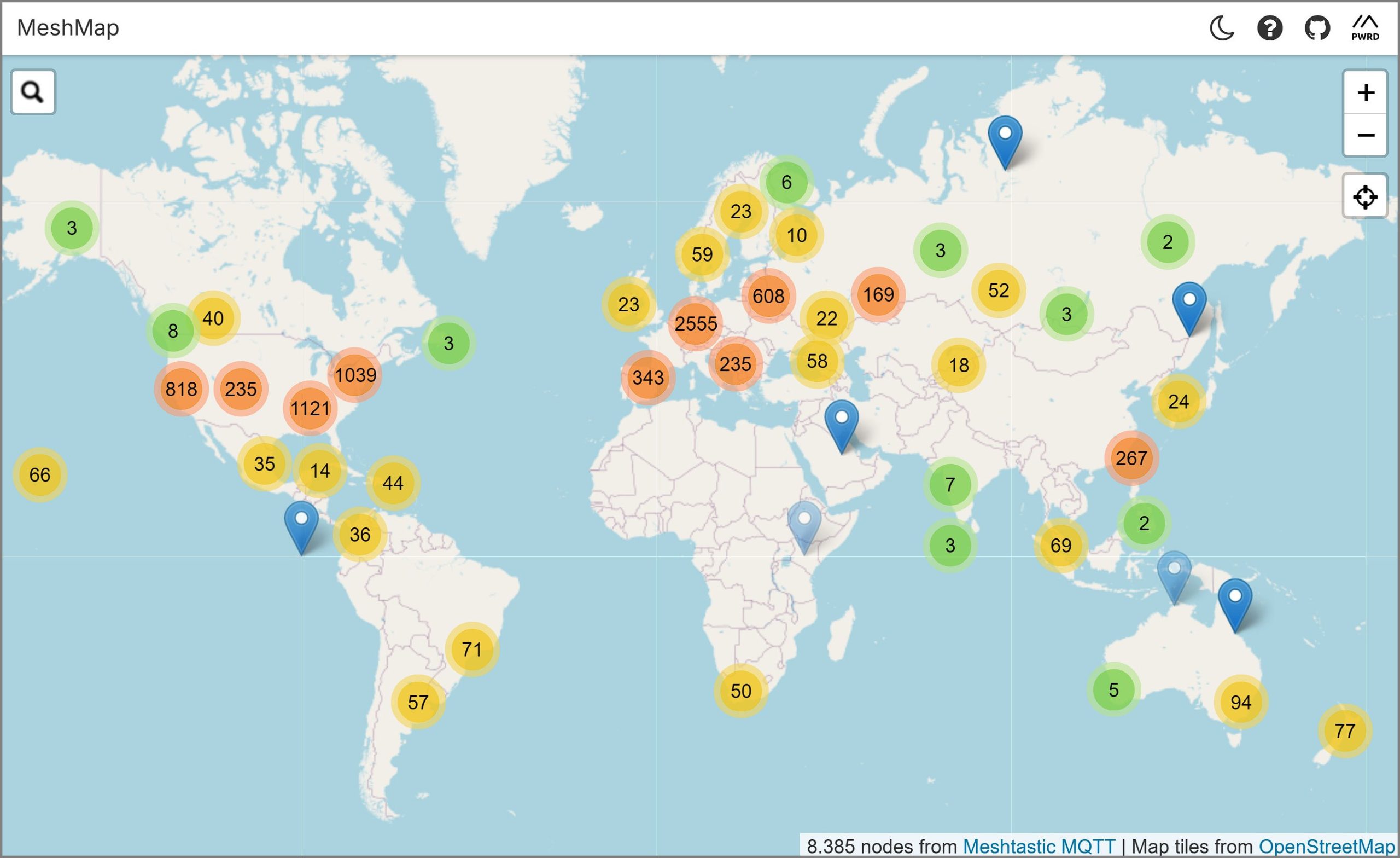
In the Meshtastic map (above screenshot from https://meshmap.net is from November 2025) are only nodes which are ‘currently’ connected to the free Meshtastic MQTT server with available GPS data. The numbers gives you an idea about the countries you can expect other devices to be online.
As a rough estimate and some valued Meshtastic contributor feedback from NomDeTom, I would expect there in general to be approx. ten times as many active Meshtastic nodes off-grid with LoRa as there are gps-enabled nodes ‘online’ with an MQTT-based internet connection, as shown at https://meshmap.net. I also like to share his ‘not backed up opinion’ that there might be heavy geographic skew in MQTT participation: users in the UK being happy to participate, Germany less so, USA and Canada not so much.
2. Potential use cases in which MeshCore appears to be the more technically suitable option
MeshCore is a newer, alternative project based on a C++ library that follows a different networking philosophy. It supports autonomous, scalable, mission-critical mesh for complex, adaptive systems (e.g; IoT sensor webs and semi-industrial networks). State-aware, so it maintains awareness of neighboring nodes and network health.
Motto: ‘Make the network itself adaptive and intelligent, a more reliable mesh for systems.’

Building a large community communication network with proper planning of fixed node deployments, roles and configuration with continuous analysis and control of the mesh network to aim efficiency. This use case is best suited to cooperative people or a single organisation in control of the MeshCore nodes.

MeshCore as the IoT radio networking for Smart farming, also known as precision agriculture, data-driven farming or automated farming: Farmers could use a LoRa mesh to connect dozens of sensors across vast fields. This allows them to monitor:
- Soil Moisture: To control irrigation systems and water only where needed.
- Remote Weather: To get hyper-local data on temperature and rainfall.
- Livestock: Track the location of cattle or other animals on large pastures.
- Equipment: Monitor fuel levels or the status of remote water pumps.
In my view, smart farming use cases should be implemented with the professional services of a reliable commercial MeshCore Solutions provider to assist with planning, deployment, configuration, testing, operations and support.
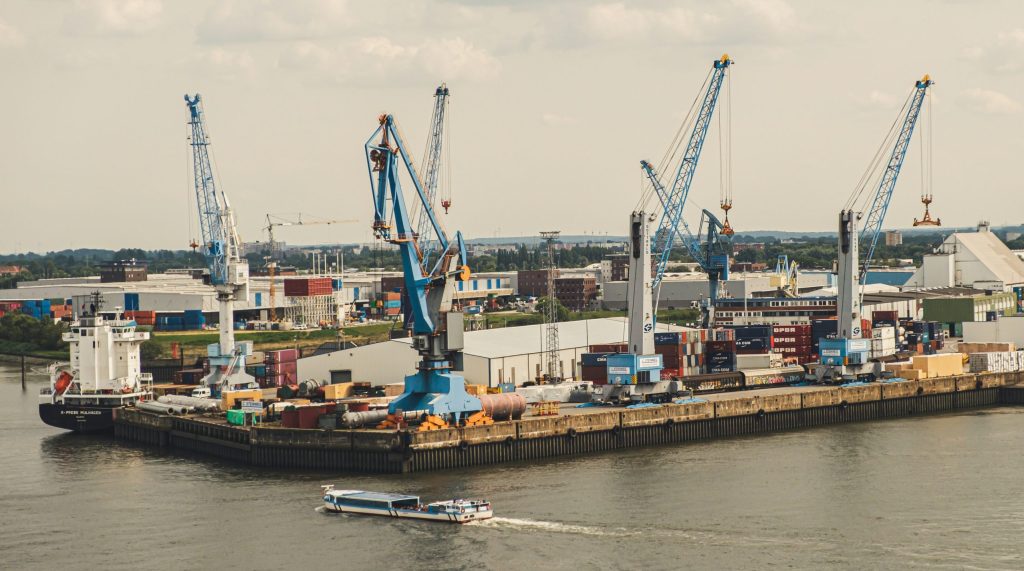
MeshCore as the IoT radio networking for Semi-Industrial IoT use cases like larger remote sensor networks and machinery control. One example with a mainly fixed infrastructure: an industrial storage depot. The area is filled with metal containers, heavy machinery, and has limited or non-existent Wi-Fi. Cellular (LTE-M) is an option, but it requires a monthly SIM card fee for every single asset, which is cost-prohibitive for thousands of sensors. Here MeshCore’s design shines because of its network efficiency, scalability and extreme low power consumption for:
- Asset Tracking: The operations manager needs to know the location of hundreds of shipping containers, chassis, and high-value portable equipment (like generators or welding carts) within the yard.
- Condition Monitoring: They need to monitor the status of critical, hard-to-reach infrastructure, such as:
- Machinery Switches: Are they in the correct position? Is the heating element working in winter?
- Refrigerated Containers: What is their current temperature and fuel level
- Pumps: Are the sump pumps in drainage culverts operational?
In my view, smart farming and semi-industrial IoT use cases have to be implemented with the professional services of a regional and commercial MeshCore Solutions provider to assist with planning, deployment, configuration, testing, operations and SLA-backed support.
MeshCore Advantages
- A more efficient mesh network for larger communities can be achieved by planning the deployment of fixed nodes with well-defined roles in strategic locations, such as on roofs or hills and utilizing the advanced networking features of MeshCore. This improves the reliability of text message deliveries and confirmations, as its routing is more efficient for fixed networks.
- Fewer telemetry beacons and reduced ‘network chatter’. Since not every node repeats everything, the network is potentially ‘quieter’ and more efficient.
- MeshCore’s delivery acknowledgements are Clear message delivery confirmations with retry feedback. Meshcore shows exact sending attempts and clearly indicates success or failure, eliminating the uncertainty present in Meshtastic’s delivery indicators.
- The MeshCore ‘room server’ BBS (bulletin board system) function, which adds persistence, reliability, and asynchronous operation. They enhance a mesh radio network with actual messaging infrastructure. Get more interesting information here: MeshCore Room Servers: The Missing Piece in Off-Grid Mesh Communications. Nevertheless Meshtastic introduced a ‘store and forward’ feature for Meshtastic devices with pSRAM (pseudo-static random-access memory).
- Due to less LoRa traffic and a quicker Bluetooth disconnection from the MeshCore app, the battery runtime of MeshCore nodes is considerably longer than that of Meshtastic on the same device.
MeshCore Disadvantages
- In ad-hoc communication scenarios, for example sports groups in the outback, MeshCore will not perform any hop routing unless at least one node is explicitly configured with the role “repeater” or as a “room server” with
repeatenabled. Therefore, reaching person C from person A via message forwarding by a node B requires an additional repeater node. - MeshCore is open source based on a MIT license except some parts like Liam’s Android/iOS mobile apps which are proprietary (closed source). The MIT license allows anyone to: Use the code commercially, modify it, combine it with proprietary software and redistribute modified versions without releasing the source code. This means a company can legally take an MIT-licensed open-source project, improve it, close new source and sell it as a commercial, proprietary product. This phenomenon is often referred to as “open-core” or “commercial capture”. It could pose a risk for solution providers, particularly in the European Union which seeks digital sovereignty. Bbecause the open-source nature of MeshCore could change if critical components become tightly dependent on a future “commercial MeshCore company” outside the EU. Such a scenario might limit options for independent solution providers and could potentially hinder EU digital sovereignty and compliance with EU regulations.
- A small one-time payment is required in the mobile apps to access the full range of features or to avoid forced waiting times and for the ripple firmware for some stand-alone devices like the Lilygo T-Deck with special management features.
- The community is significantly smaller than that of Meshtastic. As of November 2025, the MeshCore community in Discord community had approx. 3,500 members compared approx. 40,000 members for Meshtastic.
- MeshCore does not include built-in MQTT functionality. Any MQTT integration would require custom development, external gateways, or proprietary extensions, which increases implementation complexity and operational overhead. This makes MeshCore less suitable for projects that rely on standardized data exchange, automation workflows, or scalable system integration.
- Dependence on individuals, albeit brilliant developers. May Scott and Liam enjoy a long and productive life for continuous work on the proprietary parts of MeshCore!
- Several attempts to contact someone at the main MeshCore UK website (https://meshcore.co.uk/contact.html) via the promoted contact email address customer@cloudsto.com were unsuccessful. The same email address is also used by a Mini PC and electronics online store in the UK at https://cloudsto.com, suggesting that the organisational setup of MeshCore could be somewhat “rudimentary” at the time of writing this article, but will hopefully improve over time as MeshCore is still quite young.
In my humble opinion, any non-hobbyist use cases and projects with MeshCore would be very risky at the time of writing this article. Especially as the source code of the MeshCore iOS and Android mobile apps seem to be proprietary and development and bug fixing is probably dependent on a single private person. In my opinion, any company aiming to provide professional MeshCore solutions should be prepared to develop its own iOS and Android apps.
Places where MeshCore is used
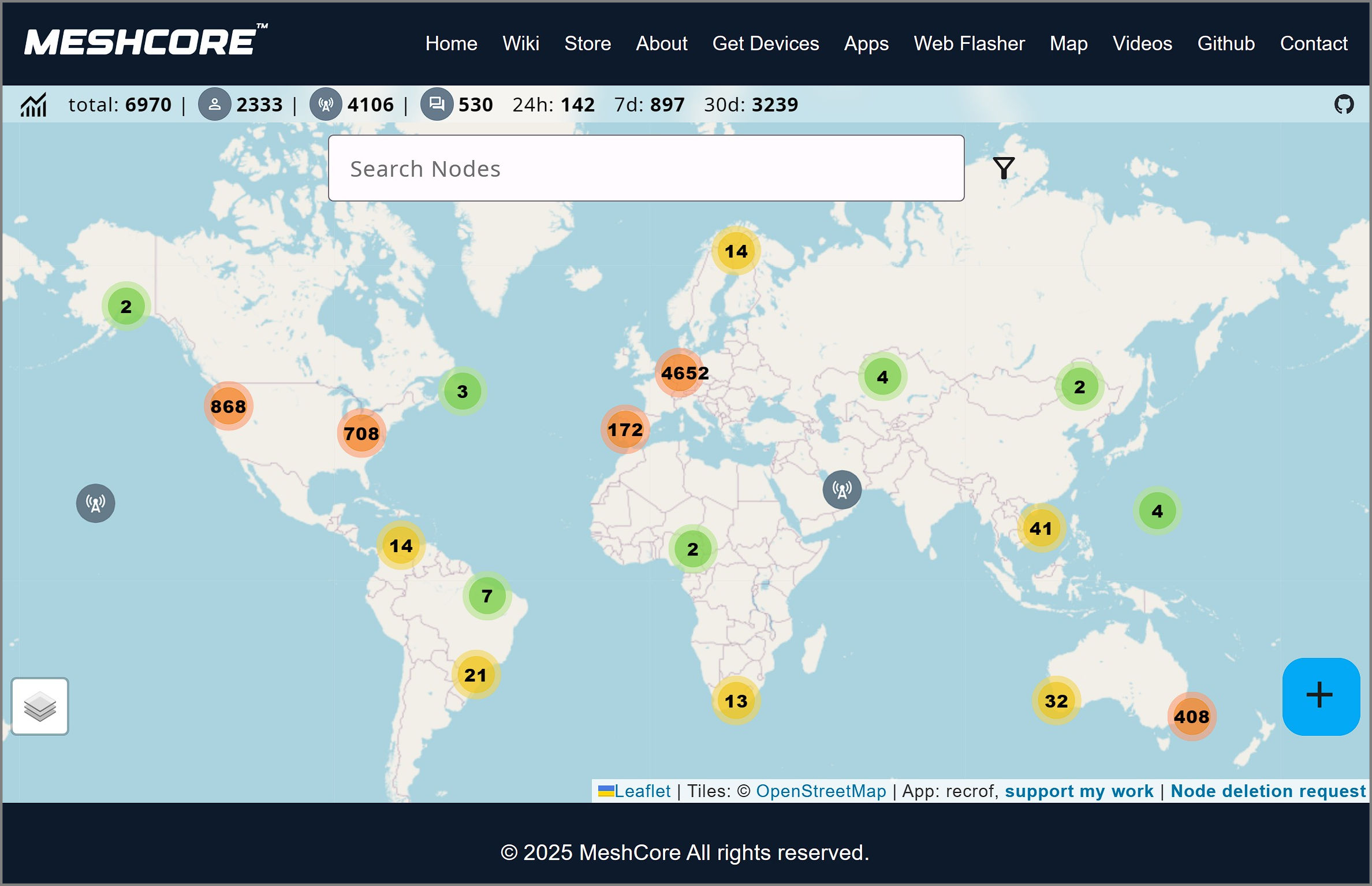
In the MeshCore map (above screenshot from https://meshcore.co.uk/map.html is from November 2025) are probably all companion nodes which are connected to the MeshCore Android or iOS app with available GPS data and which were added to the map by the “+ Add me to the Map” option in the mobile app. The numbers gives you an idea about the countries you can expect MeshCore devices to be visible in LoRa. UK and Germany are currently hotspots of MeshCore activities. The total number of MeshCore nodes visible off-grid with LoRa will be much higher.
In some very active MeshCore discussion groups, it is not uncommon to see multiple postings within a single minute. Many Meshtastic users also seem to migrate to MeshCore networks, which are often active on alternative LoRa radio settings other than ‘LongFast’. For example, better use the EU/UK (Narrow) Radio Settings to see other people on MeshCore in the European Union (EU).
Summary
Neither Meshtastic nor MeshCore is fundamentally the better system; it always depends on your use case. And let’s not forget: Competition between Meshtastic and MeshCore encourages continuous improvement and innovation in both systems.
Meshtastic seems to be the better choice if:
You are engaged in outdoor activities such as hiking or sports in remote areas, attending festivals, or in environments without prior setup or infrastructure, for example during power blackouts, firefighting teams in the woods, or avalanche rescue missions in mountainous terrain. Meshtastic excels for use cases with ad-hoc groups because it works immediately out of the box and does not rely on fixed network components.
In addition, Meshtastic benefits from a fully open-source project supported by a large community, based on a GPL license which protects Meshtastic from a “commercial capture”. The supporting organization, Meshtastic Solutions Inc., has strong potential to support the start of commercial and local Meshtastic solution providers for the development and delivery of semi-industrial IoT solutions, including long-term operation and support services with Support Level Agreements (SLAs).
MeshCore seems to be the better choice if:
You are building a permanent network across a town or city with a planned deployment of repeater and room server nodes and require reliable message delivery over longer distances. MeshCore is well suited for use cases with structured, infrastructure-based networks.
However, you should be aware of the associated risks: some components, such as the mobile apps, are proprietary, and the open-source parts are released under a permissive MIT license, which allows a “commercial capture”.
Rundown
Unfortunately, there is no sign yet of an attempt to create or support communication gateways between Meshtastic and MeshCore.
For industrial IoT use cases, better consider commercial industrial IoT platforms. Contracting a regional and professional IoT solutions company that provides reliable services with Service Level Agreements (SLAs) is the clear choice for industrial IoT projects involving liability and risk. If you are based in the EU, you might be interested in the following information: Europe’s Internet of Things policy.
Smart farming and semi-industrial IoT use cases require far more functionality than radio networking provided by Meshtastic or MeshCore. These use cases typically depend on an IoT platform or IoT middleware layer that provides:
- Device Management (e.g. secure device onboarding, health monitoring, remote configuration and firmware updates)
- Data Processing (e.g. validation and normalization, aggregation, MQTT broker for data publish-and-suscribe, rules engine for thresholds and alerts and automation, long term storage, audit trails)
- Dashboards & Visualization (e.g. real-time dashboards, historical analytics, map-based views custom KPIs, alarm & event visualization)
- Alerting & Automation (e.g. threshold and anomaly detection, workflow automation)
- Interfacing (e.g. integration with ERPs and farm management systems, data export to data lakes and BI tools, REST interface)
- If applicable: Specialities for Smart Farming (eg.soil, weather and crop sensor integration, field zoning)
- A framework for additional Business Logic which cannot be implemented with above features
A future article could eventually examine whether a carefully designed open-source stack based on Home Automation OS, Node-RED and other carefully selected open-source tools could provide the core functionality of an IoT platform for specific use cases using Meshtastic as radio networking for IoT devices.
Promisingly, Meshtastic nodes can easily exchange data with Home Automation OS (HAOS) for dashboarding and other IoT middleware functionality using the HAOS-integrated MQTT broker. Also interesting would be, where this approach reaches its limits compared to a full-fledged commercial IoT platform. If you are interested in such an article, please send an email to mesh@swiss-1.ch or leave a comment below.
Where are the Meshtastic or MeshCore Solution Providers?
To date, I have not been able to identify established regional companies that provide professional development, operations, and SLA-backed support for smart farming or semi-industrial IoT solutions using Meshtastic or MeshCore.
Therefore, in my opinion, any projects with non-hobbyist use cases involving Meshtastic or MeshCore carry an unacceptably high risk at the time of writing.
Nevertheless, Meshtastic Solutions Inc. provides responsive and competent support through its Partner Program, Certified Devices Program, and Integrator Program. They are laying the groundwork for regional solution companies that use Meshtastic to develop smart farming and semi-industrial IoT solution offerings, including operations and SLA-backed support. I’ve heard rumors that some of these companies are preparing to launch soon!
Reachability of Meshtastic Solutions vs. MeshCore website contact
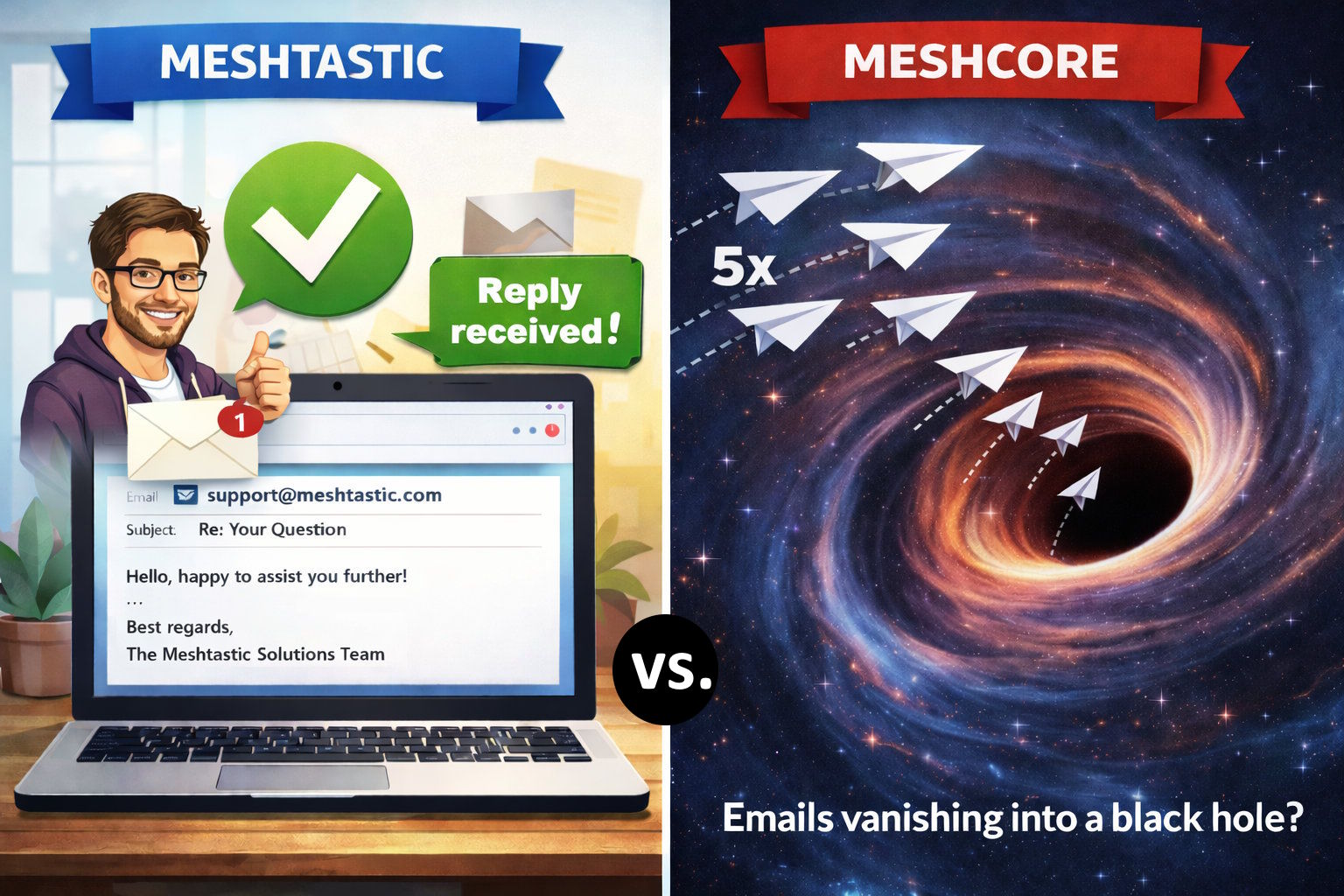
I use MeshCore on multiple devices and genuinely appreciate the reliability of its long-distance message delivery. However, at the time of writing, I would approach investments in MeshCore solutions and operational services with caution. The apparent lack of organizational support for solution providers, combined with the permissive MIT license (which allows the possibility of “commercial capture”) and the presence of proprietary components, may introduce operational, commercial, and legal risks that are difficult to quantify.
MeshCore vs. Meshtastic: More Information
Meshtastic vs. MeshCore on Austin Mesh
In this article, Tommy Ekstrand of Austin Mesh in the United States compares Meshtastic and MeshCore. Austin Mesh is technology-agnostic and prioritizes reliable, decentralized mesh networking that continues to work even when the internet or cell towers are down:
Meshtastic vs. MeshCore on Austin Mesh
Build Long-Range IoT Applications Fast With Meshtastic
MeshCore vs. Meshtastic: Key Differences Explained
The main difference between Meshcore and Meshtastic is how they handle routing, traffic control, and network scalability. In the following video, Vivian Van Zyl of LoraMeshDevices.com in Florida, USA, explains their contrasting approaches to IoT communication and GPS-based networking, highlighting each system’s strengths:
MeshCore Presentation by Liam Cottle
Liam Cottle, the brilliant developer of the proprietary MeshCore iOS and Android smartphone apps from New Zealand, gives an informative presentation about MeshCore:
Other Meshtastic blogposts
Three exceptional Meshtastic devices from Lilygo, Heltec, and Seeed
Comments are welcome
Constructive comments (via the comment function at the bottom of this page) are greatly appreciated and suitable changes and additions to this blogpost will be taken into account. All statements in this blog post reflect the personal opinion of the author, which may not always be accurate due to incomplete information and are not factual claims.
Please note that comments are subject to manual review to prevent spam, which may cause a delay in their display. Before purchasing any of these Meshtastic or MeshCore devices, please research the actual features yourself.
How do Meshtastic and MeshCore differ in terms of software compatibility?
Regards
Terapan Telkom University Dan Bank Indonesia
Both are open-source firmware stacks for LoRa-based mesh networking.
Both support a broad range of hardware (ESP32, Heltec, RAK, etc) and LoRa frequency bands (e.g., EU868, US915) but with different optimisations.
But here they differ:
Meshtastic uses a managed flooding approach: basically nodes rebroadcast messages (within a hop-limit, e.g., up to 7 hops) rather than maintaining dynamic routing tables.
MeshCore supports more advanced routing: configurable multi-hop routing, path-learning, deduplication of packets, etc.
Because the protocols differ significantly, *Meshtastic nodes and MeshCore nodes are not natively compatible with each other for direct mesh message exchange. For example, a Meshtastic-flashed device can’t “see” or talk to a MeshCore-flashed device in the mesh.
I’ve replied to you on discord, but I’ll place it here as well, for visibility :
You’ve listed real use-cases for Meshtastic and then some fantasy stuff for the other one.
E.g. condition monitoring of track switches. Railways do not rely on open source software written by volunteers to maintain their safety critical, single point of failure infrastructure.
Meshtastic has a large amount of sensor support already, and is used for smart agriculture.
Meshcore is explicitly for text messaging. Telemetry and positioning are by request only. This requires a central controller requesting the data, rather than a passive infrastructure which uploads in multiple places and manages dats gathering at scale. This is something they will explain themselves.
You may be thinking “it’s simply a matter of programming it to be different to achieve the stated use cases.” But that is true of any such use case.